
The world has moved on from the traditional year-end awards night, replete with speeches, trophies, catering and applause. Sure, those moments have their place but employees, especially Millennials and Gen Z, expect more. They want recognition that is immediate, personal, authentic, and ongoing.
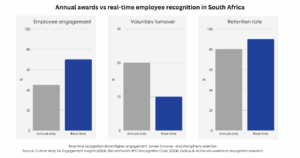
The research evidence is clear: real-time employee recognition in South Africa drives engagement, retention and performance in ways that annual awards alone no longer achieve.
Why annual awards are outdated
Out of sync with fast-paced modern work
Work is faster, roles more fluid, expectations higher. When good performance waits until an annual ceremony, the link between behaviour and reward weakens. Recognition delayed is recognition diminished.Delayed recognition leads to disengagement
When achievements are not acknowledged close to when they happen, employees feel unseen, undervalued, or ignored. Over time, these feelings erode morale and loyalty, and can increase attrition. HR leaders hear this frequently: “I only hear about what I didn’t do well”, which is hardly motivating.Emotional impact loses its force
Recognition is powerful partly because it taps into emotional rewards like pride, belonging and social connection. However, that emotional boost fades if not reinforced. A once-a-year ‘high’ is nice, but so is a cup of tea. Without regular smaller ‘peaks’, the motivational baseline drops like a stone.The case for real-time recognition
Reinforcing desired behaviours instantly
When positive behaviours, effort and performance are acknowledged quickly, by peers or managers, it reinforces what we want more of. A “good job” today is more potent than a trophy months later. Real-time feedback helps cement the connection between actions and values, encouraging repetition. Better engagement, lower turnover: local evidence- In South Africa’s BPO sector the achieve recognition and rewards programme, powered by bountiXP, saw recognition participation rise from 34% to 69% monthly, and 93% of staff receiving recognition every month.[1]
- In the same deployment, agent turnover dropped to 10%, and team leader attrition to 4%, which is far better than broader industry averages (attrition as high as 20-60%).
- According to Culture Amp, about 67% of employees in South Africa report feeling engaged. While there is room for improvement, this shows a base of receptivity to workplace practices that foster recognition and alignment.[2]
Tech-enabled recognition in South Africa
Platforms like bountiXP: always-on, data-driven
Platforms such as bountiXP recognition software make real-time employee recognition possible at scale. Rather than waiting for leadership to pick winners, all employees – peers and managers alike – can give social recognition (saying thank you), nominate rewards, or reinforce values-aligned behaviours and performance instantly.Reporting, analytics and insights
Real-time recognition not only makes for engaged and motivated employees but also directly benefits the business and leadership structures. There is power in seeing patterns. bountiXP provides interactive dashboards, behaviour analytics, reporting on recognition frequency, alignment with values, participation rates, and so on. These allow HR and executives to see where recognition is working (and where it isn’t), and to tie recognition efforts to strategic goals.Accessible, scalable, affordable
Because these platforms are cloud or SaaS-based, mobile-enabled, and peer-friendly, even large enterprises with dispersed, frontier or remote teams (like contact centres, branches and field agents) can implement recognition programmes without excessive overhead. The usage of bountiXP in South Africa’s BPO sector demonstrates scalability and real-time reach.[3]Cultural and business impact
Building a culture of appreciation
When recognition happens regularly, it becomes embedded. Colleagues see each other’s work; leaders live the values and people feel a stronger emotional connection to the work and the organisation. That drives trust, psychological safety and stimulates innovation. Recognition becomes part of the daily rhythm, not just an annual event.Retention: mission-critical in South Africa
The South African labour market is especially competitive for talent. High voluntary turnover costs organisations both in recruitment spend and in institutional knowledge lost. As noted above, companies implementing frequent recognition have seen turnover drop significantly.Employer brand and talent attraction
Candidates increasingly ask: “What’s recognition like here?” as part of their job choice. Companies that promote a culture of recognition, backed by technology, with visible activity and employee stories attract better talent and may even pay less of a salary premium as recognition can compensate for other gaps in remuneration. Recognition platforms and modern recognition strategies increasingly show up in employer reviews, LinkedIn and word of mouth.What HR leaders and executives can do now
- Audit recognition practices: measure how often recognition happens, in what forms (manager-driven, peer, social, rewards, etc.), and identify gaps.
- Shift budget and focus away from annual award events only, to blended approaches: frequent, low-cost, authentic recognition plus selective, high-impact annual moments.
- Deploy or pilot a real-time recognition platform like bountiXP: start small (teams, departments), measure uptake, sentiment, frequency and attrition/engagement outcomes.
- Align recognition with values and strategy: ensure recognition reinforces what the business needs, whether that is customer service, innovation, teamwork, quality.
- Train leaders and managers in giving authentic, behaviour-based recognition. Avoid the generic “well done” in favour of “I appreciated how you did X, which supported Y goal” – delivered almost immediately after performance.
Move beyond once-a-year awards. With solutions like bountiXP, South African businesses can build a culture of everyday recognition that inspires, engages, and retains top talent.
Chat to one of our recognition experts today to explore how we can help you design a program that truly makes recognition part of your culture.